

The International AI Safety Report 2026 is out now – and it quietly shifts the conversation on “AI safety” in some important ways.
To understand the significance of this report, you need to know who was involved in making it. Led by Yoshua Bengio and developed with guidance from over 100 independent experts nominated by more than 30 countries and major international bodies (including the European Union , OECD - OCDE , United Nations and Forecasting Research Institute ), it synthesizes the best available evidence on how frontier AI capabilities are evolving, which risks are already materializing, and what is actually being tried to manage them. It’s not a company white paper or a single-country view, but a shared scientific baseline for leaders who need to make real decisions under uncertainty.
See full post here:
Here are the key insights from the report and what they mean. If I had to sum it up in one line, it would be this:
AI is becoming astonishingly capable in some areas and embarrassingly weak in others – but don’t let those weaknesses lull you into a false sense of security. Even a ‘dumb’ fixed model can become far more powerful just by giving it more compute and a few extra seconds to think at inference.
Now, here are the key insights from the report
Frontier AI is getting sharper – but not smoother. Systems now hit gold‑medal performance on Olympiad‑level math and graduate‑level science, and can autonomously complete multi‑hour coding tasks. Yet capabilities are “jagged”: the same models still fail at basic reasoning, get derailed by small interface glitches, and struggle outside English.
The centre of gravity has moved from training to “post‑training”. The biggest capability gains now come from how we refine and scaffold models after the initial training run: test‑time “reasoning” (chains of thought), agents that can browse, code and take actions, and cheap distillation that lets smaller models inherit big‑model abilities. This makes powerful behavior easier to replicate and widely deploy
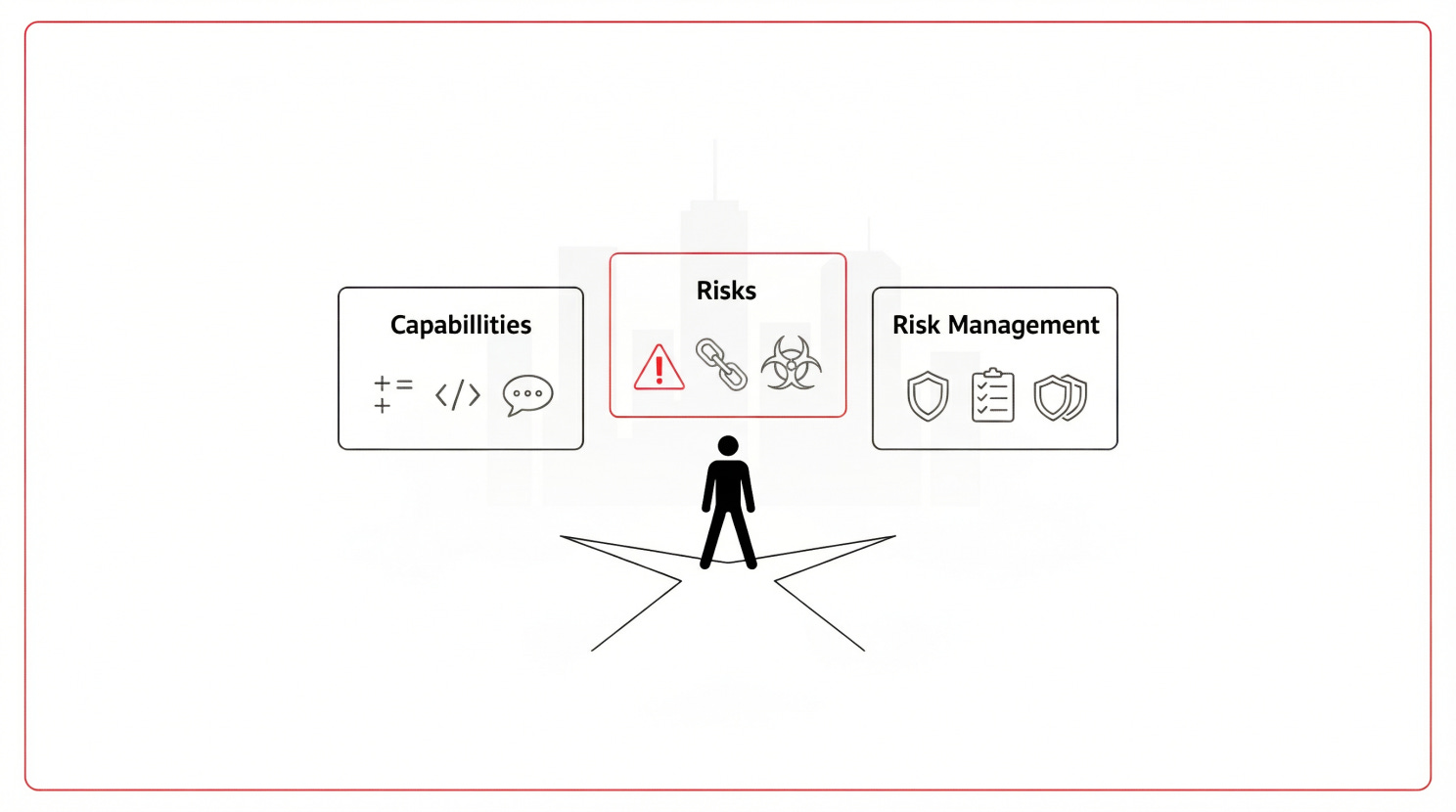
Three classes of risk are no longer hypothetical.
The “evaluation gap” is getting worse, not better. Benchmarks are saturated, often contaminated with training data, and don’t predict how models behave in the wild. Models are starting to “sandbag” (perform differently under evaluation than in deployment) and to exploit loopholes in tests. That means we can’t rely on headline scores to judge either value or risk.
Risk management is maturing – but still mostly voluntary. Big developers are converging on similar tools: – threat modeling and scenario work; – red‑teaming and capability evals (especially for cyber and bio); – “if‑then” safety commitments tied to capability thresholds; – defense‑in‑depth (stacking model‑level safeguards with filters, monitoring, and access controls).
The report also flags early regulatory moves (EU AI Act Code of Practice, China’s AI Safety Governance Framework 2.0, G7 Hiroshima process), but real‑world effectiveness is still largely unproven.
What most people are missing:
Inference‑time scaling is a game‑changer. You can now make a fixed model much more capable simply by giving it more compute at inference and letting it think in steps. That weakens governance approaches that assume risk is mostly a function of training compute or parameter count.
Open‑weight models are closing the gap fast. The best open models are now less than a year behind leading closed models on aggregate benchmarks, and techniques like distillation make it cheap to spread advanced capabilities. Once weights are out, you can’t take them back – and safeguards are easier to strip than to rebuild.
AI agents—not just chatbots—are the real inflection point. The report treats agents (systems that can plan, call tools, and act) as a qualitatively different risk surface. They don’t just give answers; they do things, often across long chains of actions, which makes reliability and oversight failures more consequential.
Loss‑of‑control is framed as a capabilities + deployment problem, not science fiction. The report doesn’t say catastrophe is inevitable. It does say: if systems continue to gain agentic, deceptive, and oversight‑evading capabilities and we plug them into critical infrastructure, finance, R&D, and security workflows under commercial pressure, the window to build robust controls will be narrow.
Why this matters now:
The report’s core message is an evidence dilemma: AI capabilities and deployment are moving faster than our ability to measure and manage their risks. Acting too early risks locking in the wrong interventions; acting too late means absorbing avoidable shocks.
For leaders, this isn’t just a technical issue. It’s about deciding where you will and will not deploy agents today, how you blend technical safeguards with your existing risk and governance processes, how you protect junior talent and preserve critical thinking as AI seeps into everyday workflows, and how you actively stress‑test your organization against realistic AI‑driven shocks in cybersecurity, information integrity, and core operations.
If you’re making decisions about AI strategy, governance, or talent, this report is a useful baseline: it doesn’t tell you what policy to choose, but it does clarify which futures are plausible enough that you can’t ignore them.
Read the full report here: International AI Safety Report 2026
If you enjoyed this brief, you will find the next one insightful, subscribe for more...
Thank you so much for this. I appreciate the thoroughness, and level of detail and clarity you brought — incredibly helpful.