

Manus is a Singapore-based AI startup founded by Chinese entrepreneurs. Its product spins up a virtual computer environment, operates it the way a human user would - clicking, typing, navigating apps - and completes tasks end to end. It can also download files, open them, and read them as part of the workflow.
From Chatbots to “Do‑Bots”
For a while, most people’s experience of AI has been chat-based: you type, it replies.
Manus flipped that script by building an AI agent that can actually use a computer - like opening tabs, logging into apps, copying data, filling forms, and coordinating dozens of steps without you watching every move.
Instead of a single model answering a single prompt, Manus runs swarms of agents on virtual machines it controls, each able to browse, click, read, and write like a digital worker. As Daniel L. described it on LinkedIn, instead of a single AI agent working through tasks step by step, Manus Wide Search can spin up 100 AI Agents working together.
Think of it as moving from “an AI that drafts an email” to “an AI that researches 50 prospects, drafts and sends the emails, updates your CRM, and books meetings on your calendar.” MGX
What Makes Manus Different
Several features made Manus stand out in a crowded AI market and helped explain Meta’s interest.
General-purpose agent: Manus was marketed as a general AI agent that could handle a wide variety of tasks end‑to‑end, not just narrow workflows. Baptista Research
Real computer use: It could control a browser and operating system directly, anticipating later “computer use” features from larger labs and proving they could work at scale. Gist
Wide Research: Manus’s “Wide Research” capability broke big problems into many smaller tasks and deployed parallel agents to work across hundreds of sources before synthesizing an answer, effectively working around traditional context window limits. Manus
Built for work, not just demos: The product focused on repeatable workflows - research, outreach, operations - that businesses could plug into existing processes without custom development. LinkedIn
Under the hood, Manus looked less like a chatbot and more like an orchestration layer: planning what needs to be done, choosing the right tools, and then executing through its own fleet of cloud computers.
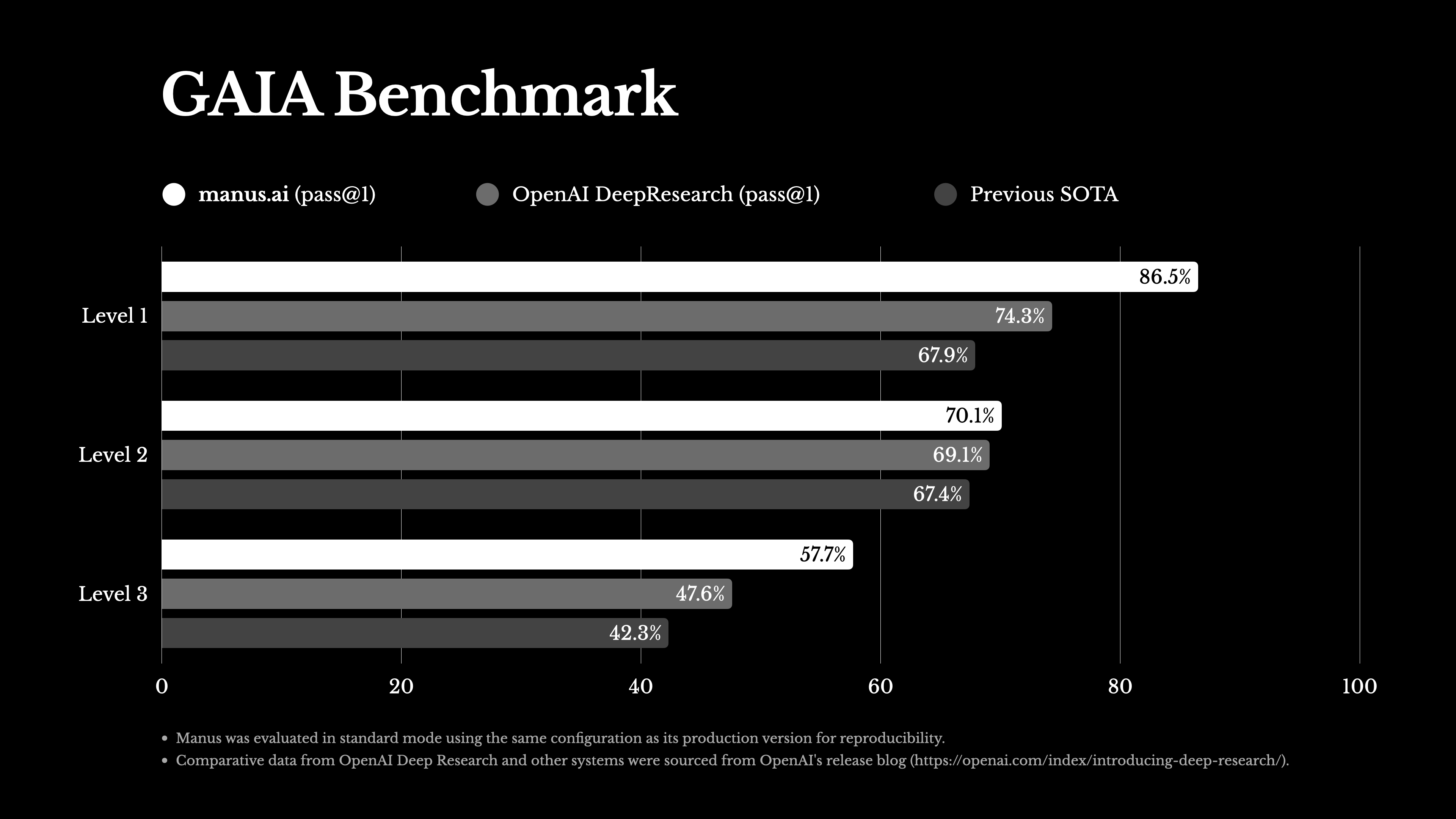
That orchestration is precisely what turns large language models from clever talkers into dependable “do‑bots” for organizations. And precisely the reason Manus stands out on the GAIA Benchmark.
Why Meta Paid More Than $2 Billion
On paper, the deal is simple: Meta acquired Manus for more than $2 billion and is keeping it as a Singapore‑based subsidiary with ongoing subscription services. The Wall Street Journal
Behind that headline, there are three strategic reasons that matter for policy, business, and the broader AI ecosystem.
First, Meta is pairing its own “AI brain” (Llama models) with Manus’s “hands” (agentic execution).
Meta has world‑class open models and billions of users across Facebook, Instagram, and WhatsApp, but until now lacked a mature, battle‑tested agent framework for complex workflows as described by Aragon Research.
Buying Manus gives Meta an off‑the‑shelf system that can plug into those platforms and turn generic AI capability into specific, monetizable services - customer support agents, sales and marketing automation, back‑office workflows etc.
Second, Manus was already a real business, not a research bet.
Reports and industry analysis suggest Manus had attracted millions of paying users and substantial recurring revenue before acquisition, validating a willingness to pay for agents that actually perform work rather than just answer questions. MGX
For Meta, this is not just about technology acquisition; it is about importing a proven go‑to‑market motion for agentic AI, especially with small and mid‑sized businesses.
Third, Meta is buying time.
Building a robust, secure, and scalable agent system on top of foundation models is slow, especially when it needs to operate across messaging, social, and enterprise contexts.
By acquiring Manus, Meta shortcuts years of iteration and positions itself to compete more directly with emerging agent offerings from other major players.
The Part Most Readers Miss
Most deal coverage stops at valuation and product features. For policymakers, leaders, and practitioners, the Manus acquisition signals deeper shifts that deserve attention.
Agents as a new layer of digital infrastructure
Manus is an early example of a new layer: agents that sit between users and the web of SaaS tools, effectively becoming a control plane for work. If Meta succeeds in embedding Manus-like capabilities into WhatsApp Business, Instagram Shops, and enterprise tools, a large share of routine digital labor - customer support, lead qualification, research, reporting - could be mediated by Meta‑run agents. Baptista Research
This raises structural questions: who controls the agent layer, who sets default behaviors, and how easy it is for businesses and governments to move between providers once workflows are deeply agent‑embedded.
In practice, control of agents may become as important a policy concern as control of app stores or ad networks.Geopolitics and AI as a strategic asset
Manus’s Chinese roots and Singapore base have already drawn scrutiny.
Chinese authorities have opened an assessment of whether the Manus sale violates emerging rules on exporting advanced AI capabilities, underscoring how agentic systems are being treated as strategic technology, not just commercial software. More on CNBC
The deal also sets a template: Manus has moved to cut mainland ties and refocus as a non‑Chinese operation under Meta, a pattern likely to recur as global firms acquire AI companies with mixed jurisdictional exposure. Davis Polk
For regulators, that raises questions about where core intellectual property is developed, how it is transferred, and what safeguards are in place when highly capable agents can be repurposed across borders.Governance, accountability, and invisible automation
Agentic systems like Manus create value precisely because they act without constant human supervision. That also means mistakes, biases, or abuses can propagate quietly if logging, oversight, and constraints are weak.
For platforms like Meta, deploying these agents across billions of users will require:Detailed action logs and audit trails so organizations can see what an agent did, when, and why. ALM
Guardrails that restrict which systems an agent can access, what data it can handle, and how it escalates risky decisions. System in Motion
Clear allocation of responsibility when an agent makes a harmful or unlawful choice on behalf of a business or individual.
These design choices will become policy issues, not just product decisions, as agents touch regulated sectors like finance, health, and public services.
What This Means for Work and Policy
For work, agents like Manus point toward a future where individuals and small teams can operate with leverage that once required entire departments.
A solo realtor can have an agent that prospects, drafts listings, coordinates with clients, and keeps the CRM up to date; a two‑person online shop can run support, marketing campaigns, and supplier coordination largely through agents.
For policy, the key question is not whether agents will arrive, but who will own and shape the infrastructure that powers them.
Meta’s purchase of Manus signals that major platforms intend to own that layer, combining models, data, distribution, and now execution into a single stack. As VentureBeat put it…
”Manus has consistently positioned itself less as an assistant and more as an execution engine.”
Seen through that lens, the Manus acquisition is less about one startup and more about the early architecture of the agentic internet: an emerging world where AI workers sit inside our messaging apps and platforms, carrying out tasks in the background - and where the rules of that world are still very much up for debate.