

Series: The AI Governance Blueprint - Article 7 of 7
Executive Summary
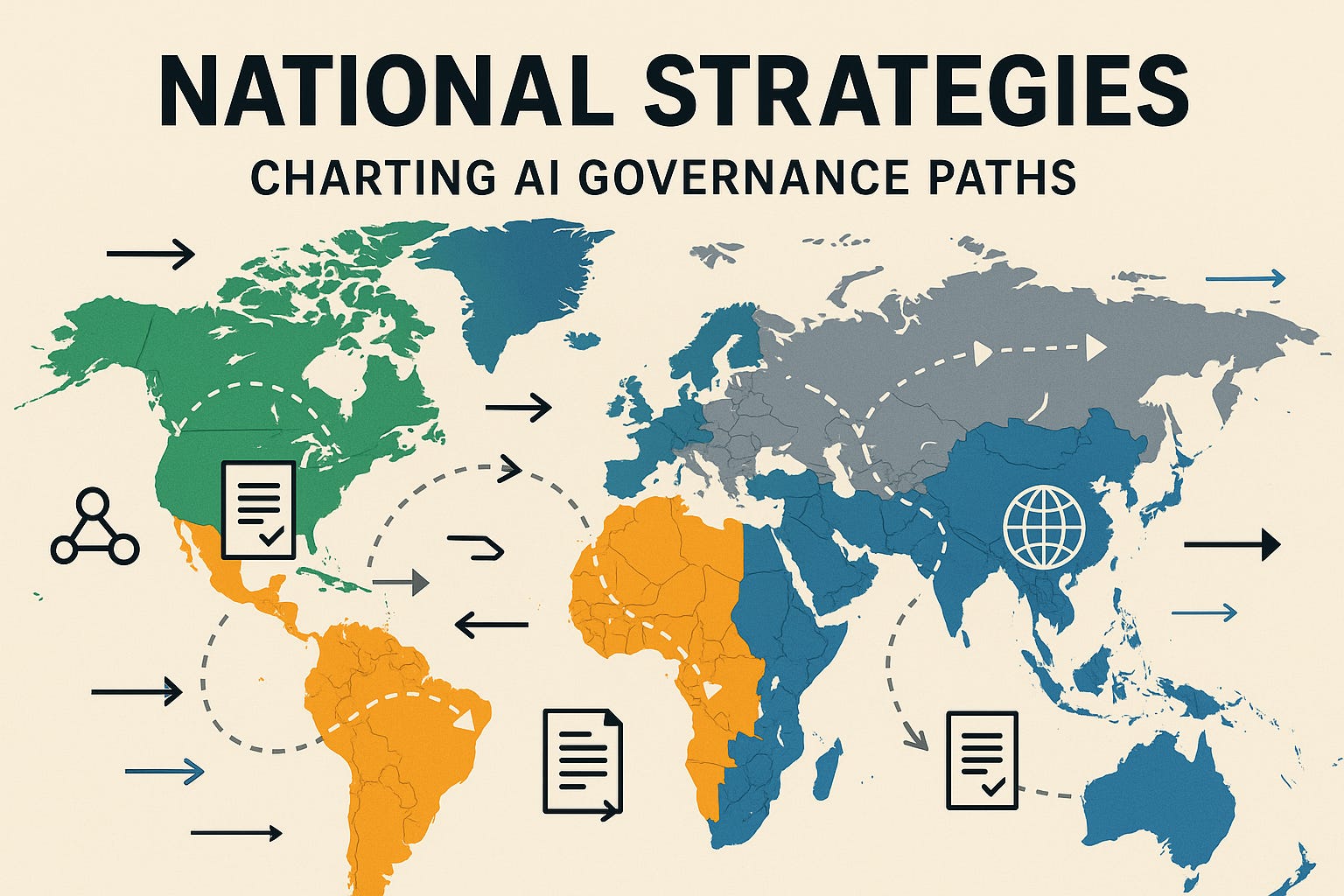
While international frameworks like the OECD AI Principles and the EU AI Act capture headlines, some of the most consequential AI governance decisions are being made at the national level. From China's comprehensive AI strategy to Singapore's model AI governance framework, from the UK's innovation-focused approach to Canada's directive on automated decision-making, countries around the world are developing distinctly national approaches to AI governance that reflect their unique values, capabilities, and strategic priorities.
These national strategies represent more than just policy documents - they're expressions of how different societies want to shape their relationship with artificial intelligence. Some countries prioritize economic competitiveness and technological leadership. Others emphasize human rights and social protection. Still others focus on specific sectors like healthcare or defense where they see particular opportunities or risks.
What emerges from this global landscape is not convergence toward a single model, but rather a rich diversity of approaches that reflect different national contexts and priorities. This diversity is both a strength and a challenge for global AI governance. It provides multiple models for how AI can be governed responsibly, but it also creates complexity for multinational organizations and potential fragmentation in global AI development.
Understanding these national approaches is crucial for anyone working in AI governance, whether as a policymaker, business leader, or civil society advocate. National strategies often provide the most direct and immediate governance frameworks that organizations must navigate, and they're increasingly influential in shaping global AI governance norms.
Key Takeaways
National AI strategies reflect diverse approaches to balancing innovation, competitiveness, and social protection in AI governance
Leading countries have developed distinct models: China's state-led approach, the US market-driven framework, the EU's rights-based regulation, and Singapore's pragmatic governance
Sectoral approaches are common, with countries focusing AI governance efforts on specific high-risk or high-opportunity areas like healthcare, finance, and public services
Implementation mechanisms vary widely, from binding regulations to voluntary guidelines, from centralized oversight to distributed governance
International cooperation and coordination are increasing, but significant differences in national approaches remain
The "AI governance trilemma" forces countries to choose between innovation, control, and openness, leading to different strategic trade-offs
National strategies are evolving rapidly as countries learn from experience and respond to technological developments
The Sovereignty Question: Why Nations Chart Their Own AI Paths
There's something fascinating about watching countries grapple with artificial intelligence governance. Unlike climate change or trade, where international coordination seems obviously necessary, AI governance reveals deep tensions between global cooperation and national sovereignty. Each country faces the same fundamental question: How do we harness AI's benefits while managing its risks in ways that reflect our values and serve our interests?
The answers vary dramatically. China sees AI as a strategic technology crucial for national power and social stability, leading to comprehensive state-led governance that prioritizes control and coordination. The United States views AI through the lens of innovation and competition, favoring market-driven approaches with minimal regulatory interference. The European Union emphasizes fundamental rights and human dignity, creating comprehensive legal frameworks that prioritize protection over speed, as discussed in analyses of AI governance approaches.
These differences aren't just policy preferences - they reflect deeper philosophical and cultural differences about the role of technology in society, the relationship between individuals and the state, and the balance between innovation and protection, as explored in studies on cultural values in AI governance.
Consider how different countries approach facial recognition technology. China has deployed it extensively for public security and social management, viewing it as a tool for maintaining social order. The United States has seen a patchwork of local bans and corporate moratoria, reflecting concerns about privacy and civil liberties. The European Union has largely prohibited its use in public spaces, prioritizing fundamental rights over security benefits, as highlighted in research on algorithmic surveillance.
These different approaches create what scholars call the "AI governance trilemma" - the difficulty of simultaneously maximizing innovation, maintaining democratic control, and preserving openness to international cooperation. Countries must choose which of these values to prioritize, leading to different strategic trade-offs, as outlined in AI governance research agendas.
The sovereignty dimension of AI governance is complicated by AI's inherently global nature. AI systems are often developed by multinational teams, trained on global datasets, and deployed across borders. The algorithms powering social media platforms or search engines operate globally, making purely national governance approaches incomplete, as discussed in analyses of algorithmic bias.
Yet countries persist in developing national AI strategies because AI governance touches on core sovereign functions: protecting citizens, maintaining security, promoting economic development, and preserving social values. These functions can't be fully delegated to international organizations or left to market forces, as supported by works on power and interdependence.
The result is a complex landscape where national strategies interact with international frameworks, corporate policies, and technical standards in ways that are sometimes complementary and sometimes conflicting. Understanding this landscape requires examining how different countries have approached the AI governance challenge.
The Great Powers: Competing Visions of AI Governance
The world's major powers have developed distinctly different approaches to AI governance that reflect their broader strategic priorities and governance philosophies. These approaches are increasingly influential globally as other countries look to successful models and as great power competition extends into the AI domain.
China: The Comprehensive State-Led Model
China's approach to AI governance is perhaps the most state power driven and centralized in the world. The Chinese government views AI as a strategic technology crucial for national competitiveness, social stability, and state power, leading to governance frameworks that prioritize coordination, control, and alignment with state objectives, as discussed in analyses of China's AI policy.
China's AI governance strategy is built around several key principles. State leadership ensures that AI development serves national strategic objectives rather than just market forces. Comprehensive planning coordinates AI development across sectors and regions. Social stability considerations ensure that AI deployment doesn't disrupt social order or challenge state authority, as outlined in China's AI strategy.
The institutional framework for AI governance in China is complex and multi-layered. The Central Committee of the Communist Party provides overall strategic direction. The State Council coordinates policy implementation across government agencies. Specialized bodies like the National Development and Reform Commission oversee specific aspects of AI development and governance, as detailed in the New Generation AI Development Plan.
China's approach to AI governance is notably sectoral, with different frameworks for different applications. AI used in financial services faces strict oversight from banking regulators. AI used in healthcare must comply with medical device regulations. AI used in autonomous vehicles follows transportation safety requirements, as highlighted in the AI Index China Chapter.
The Chinese model emphasizes the importance of data governance as a foundation for AI governance. China has developed comprehensive data protection laws that balance individual privacy rights with state security needs and economic development objectives. This approach reflects the view that data governance and AI governance are inseparable, as discussed in analyses of China's data privacy system.
China's AI governance approach has been influential globally, particularly among countries that share similar governance philosophies or strategic priorities. The Chinese model demonstrates how comprehensive state-led governance can coordinate AI development while maintaining social stability, as explored in reports on China's AI strategy implementation.
United States: The Innovation-First Market Model
The United States has taken a markedly different approach to AI governance, emphasizing innovation, competition, and market-driven solutions over comprehensive regulation. This approach reflects American values of entrepreneurship, limited government, and technological leadership, as outlined in America’s AI Action Plan.
The US approach is built around several core principles. Innovation leadership prioritizes maintaining American technological superiority in AI. Market-driven development relies on private sector innovation rather than state planning. Sectoral regulation addresses specific AI applications through existing regulatory frameworks rather than comprehensive new laws.
The institutional framework for AI governance in the United States is distributed across multiple agencies and levels of government. The White House provides strategic coordination through bodies like the National AI Initiative Office. Federal agencies regulate AI applications within their jurisdictions. State and local governments address specific AI uses like facial recognition and algorithmic decision-making, as discussed in reports on AI and national security.
The US approach emphasizes voluntary standards and industry self-regulation over mandatory requirements. Organizations like the National Institute of Standards and Technology develop guidance and frameworks that organizations can adopt voluntarily. Industry associations create codes of conduct and best practices, as highlighted in the NIST AI Risk Management Framework.
Recent developments have seen some movement toward more prescriptive regulation, particularly in response to concerns about AI safety and national security.
The American model has been influential among countries that prioritize innovation and economic competitiveness. It demonstrates how market-driven approaches can foster rapid AI development while relying on existing institutions and legal frameworks for governance, as discussed in AI policy primers.
European Union: The Rights-Based Regulatory Model
The European Union's approach to AI governance, embodied in the AI Act, represents the most comprehensive regulatory framework for AI in the world. This approach prioritizes fundamental rights, human dignity, and democratic values over pure innovation or economic considerations, as first detailed in the EU AI Act proposal.
The EU approach is built around several key principles. Fundamental rights protection ensures that AI systems respect human dignity and democratic values. Risk-based regulation applies proportionate requirements based on the potential for harm. Legal certainty provides clear rules that organizations can follow, as discussed in analyses of the draft EU AI Act.
The institutional framework for AI governance in the EU involves multiple levels and institutions. The European Commission develops policy and oversees implementation. National competent authorities enforce requirements within member states. The European AI Office coordinates oversight of general-purpose AI models, as specified in the EU AI Act.
The EU approach emphasizes the importance of democratic oversight and accountability in AI governance. The AI Act was developed through extensive consultation with stakeholders and democratic deliberation in the European Parliament and Council. Implementation involves ongoing democratic oversight, as supported by the AI4People ethical framework.
The European model has been influential globally through the "Brussels Effect" - the tendency for EU regulations to become global standards because of the EU's market size and regulatory approach. Many countries are studying the AI Act as they develop their own AI governance frameworks, as highlighted in analyses of the "Brussels Effect".
Other Significant Approaches
Beyond the great powers, several other countries have developed notable approaches to AI governance that offer different models and insights.
Singapore has developed a pragmatic, sector-specific approach that emphasizes practical implementation over comprehensive regulation. The Model AI Governance Framework provides voluntary guidance that organizations can adapt to their specific contexts.
The United Kingdom has emphasized innovation and flexibility, developing principles-based approaches that rely on existing regulators rather than new comprehensive laws. The UK's approach prioritizes maintaining London's position as a global AI hub, as outlined in the National AI Strategy.
Canada has focused on specific applications of AI in government, developing comprehensive requirements for automated decision-making in federal agencies. This sectoral approach provides a model for governing AI in public sector applications, as detailed in the Directive on Automated Decision-Making.
Sectoral Strategies: Governing AI Where It Matters Most
While some countries have developed comprehensive AI governance frameworks, many have chosen sectoral approaches that focus on specific applications or industries where AI poses particular risks or opportunities. These sectoral strategies often provide more detailed and practical guidance than broad frameworks.
Healthcare: Balancing Innovation and Safety
Healthcare represents one of the most active areas for AI governance development, reflecting both the enormous potential benefits of AI in healthcare and the serious risks posed by AI systems that affect human health and safety, as discussed in research on AI in healthcare.
Many countries have developed specific frameworks for AI in healthcare that build on existing medical device regulations while addressing the unique characteristics of AI systems. These frameworks typically address issues like clinical validation, ongoing monitoring, and physician oversight, as explored in studies on high-performance medicine.
The United States Food and Drug Administration has developed a comprehensive framework for regulating AI-based medical devices that emphasizes the importance of real-world performance monitoring and adaptive regulation. This approach recognizes that AI systems may change over time in ways that traditional medical devices do not, as outlined in the FDA's AI/ML Action Plan.
The European Union's Medical Device Regulation includes specific provisions for AI-based devices that require clinical evidence, post-market surveillance, and ongoing safety monitoring. These requirements are being integrated with the broader AI Act framework, as detailed in the EMA's AI reflection paper.
Other countries have developed their own approaches to AI in healthcare governance. Canada has created specific guidance for AI-based medical devices, as outlined in Health Canada's guidance. Japan has established regulatory sandboxes for testing innovative AI healthcare applications. Australia has developed principles for AI in healthcare that emphasize transparency and accountability.
Financial Services: Managing Algorithmic Risk
Financial services represent another area where many countries have developed specific AI governance frameworks, reflecting concerns about algorithmic bias, systemic risk, and consumer protection, as discussed in BIS's AI in financial services report.
Banking regulators around the world have developed guidance for AI use in financial services that addresses issues like model risk management, algorithmic fairness, and explainability. These frameworks typically build on existing risk management requirements while addressing AI-specific challenges, as highlighted in the FSB's AI in financial services report.
The United States has seen multiple agencies develop AI guidance for financial services. The Federal Reserve has issued guidance on model risk management that covers AI systems, as outlined in SR 11-7. The Consumer Financial Protection Bureau has provided guidance on algorithmic decision-making in lending.
The European Union's AI Act includes specific provisions for AI systems used in credit scoring and loan approval that require transparency, human oversight, and bias testing. These requirements complement existing financial services regulations
Other jurisdictions have developed their own approaches. The United Kingdom's Financial Conduct Authority has created guidance on algorithmic decision-making in financial services. Singapore's Monetary Authority has developed principles for responsible AI use in finance, as outlined in the MAS FEAT principles.
Public Sector: Governing Government AI
Many countries have developed specific frameworks for AI use in government and public services, recognizing that government AI systems raise particular concerns about accountability, fairness, and democratic governance.
These frameworks typically address issues like algorithmic transparency, public participation in AI system development, and mechanisms for challenging automated decisions. They often require higher standards for government AI systems than for private sector applications, as highlighted in studies on technological due process.
Canada's Directive on Automated Decision-Making requires federal agencies to assess the impact of automated decision-making systems and implement appropriate safeguards. This directive includes requirements for transparency, quality assurance, and human review.
The Netherlands has developed an Algorithm Register that requires government agencies to publish information about their algorithmic decision-making systems. This transparency initiative aims to increase public accountability and trust.
The United States has seen various initiatives at federal, state, and local levels to govern AI use in government. New York City has created an Automated Decision Systems Task Force. The federal government has issued guidance on AI use in federal agencies.
Law Enforcement: Balancing Security and Rights
AI use in law enforcement has generated particular controversy and regulatory attention, reflecting tensions between public safety benefits and civil liberties concerns, as discussed in works on big data policing.
Many jurisdictions have developed specific frameworks for AI use in law enforcement that address issues like facial recognition, predictive policing, and automated license plate readers. These frameworks often include restrictions on certain uses and requirements for oversight and accountability, as highlighted in reports on police facial recognition.
Several US cities and states have banned or restricted facial recognition use by law enforcement, reflecting concerns about accuracy, bias, and civil liberties. These bans often include exceptions for specific uses like airport security or missing persons cases, as discussed in analyses of police body cameras.
The European Union's AI Act includes specific provisions for AI use in law enforcement that generally prohibit real-time facial recognition in public spaces while allowing some exceptions for serious crimes. These provisions reflect the balance between security needs and fundamental rights.
Other countries have developed their own approaches. The United Kingdom has created guidance for police use of facial recognition technology, as outlined in the UK Parliament's algorithm inquiry. Australia has conducted inquiries into AI use in law enforcement and developed recommendations for governance.
Implementation Mechanisms: From Principles to Practice
Understanding national AI governance strategies requires examining not just what countries want to achieve, but how they're trying to achieve it. The mechanisms countries use to implement AI governance vary widely, reflecting different legal traditions, institutional capabilities, and strategic priorities.
Regulatory Approaches: Hard Law vs. Soft Law
Countries have adopted different approaches to the legal status of their AI governance frameworks, ranging from binding regulations with enforcement mechanisms to voluntary guidelines and best practices, as discussed in research on hard and soft law.
Hard law approaches create legally binding obligations with enforcement mechanisms and penalties for non-compliance. The EU AI Act represents the most comprehensive example of this approach, creating detailed legal requirements backed by significant penalties.
Soft law approaches rely on voluntary adoption of guidelines, standards, and best practices. These approaches often provide more flexibility and can be updated more quickly than formal regulations, but they may lack enforcement mechanisms, as explored in analyses of soft law in European integration.
Many countries have adopted hybrid approaches that combine elements of hard and soft law. They may create binding requirements for specific high-risk applications while providing voluntary guidance for other uses, as discussed in studies on international soft law.
The choice between hard and soft law approaches often reflects broader governance philosophies and institutional capabilities. Countries with strong regulatory traditions and enforcement capabilities may favor hard law approaches. Countries that prioritize flexibility and innovation may prefer soft law approaches, as highlighted in research on governance without a state.
Institutional Arrangements: Centralized vs. Distributed Governance
Countries have adopted different institutional arrangements for AI governance, ranging from centralized oversight bodies to distributed governance across existing agencies, as discussed in studies on multi-level governance.
Centralized approaches create new institutions specifically responsible for AI governance. These institutions may have broad authority across sectors and applications, providing coordination and consistency in AI governance.
Distributed approaches rely on existing institutions and agencies to govern AI within their existing jurisdictions. This approach leverages existing expertise and authority but may create coordination challenges, as discussed in analyses of multi-level governance theory.
Many countries have adopted hybrid approaches that combine central coordination with distributed implementation. They may create central bodies for strategy and coordination while relying on sectoral regulators for specific applications, as highlighted in research on multi-level governance evolution.
The choice of institutional arrangement often reflects existing governance structures and political considerations. Countries with strong central government traditions may favor centralized approaches. Federal systems may prefer distributed approaches that respect existing jurisdictional boundaries, as discussed in studies on intergovernmental relations.
Enforcement Mechanisms: Carrots and Sticks
Countries have developed different mechanisms for encouraging compliance with AI governance requirements, ranging from penalties and sanctions to incentives and support, as explored in works on understanding regulation.
Penalty-based approaches rely on fines, sanctions, and other punitive measures to encourage compliance. These approaches can be effective but may create adversarial relationships between regulators and industry.
Incentive-based approaches use positive measures like tax benefits, grants, and preferential treatment to encourage compliance. These approaches may be more collaborative but may be less effective at preventing harmful behavior, as highlighted in research on smart regulation.
Support-based approaches provide guidance, training, and technical assistance to help organizations comply with AI governance requirements. These approaches recognize that compliance may require new capabilities and knowledge.
Most countries use combinations of these approaches, tailoring their enforcement mechanisms to different types of organizations and applications. They may use penalties for serious violations while providing support for organizations trying to comply, as explored in works on regulatory capitalism.
Monitoring and Evaluation: Learning from Experience
Countries are developing mechanisms for monitoring the effectiveness of their AI governance frameworks and adapting them based on experience and changing circumstances, as discussed in research on better regulation.
Performance monitoring involves tracking metrics related to AI governance objectives, such as the number of AI systems deployed, incidents reported, or compliance rates achieved. This monitoring helps assess whether governance frameworks are achieving their intended goals, as explored in works on managing regulation.
Impact assessment involves evaluating the broader effects of AI governance frameworks on innovation, competitiveness, and social outcomes. This assessment helps identify unintended consequences and opportunities for improvement, as discussed in analyses of regulatory impact assessment.
Stakeholder feedback mechanisms provide ways for affected parties to provide input on AI governance frameworks and their implementation. This feedback helps identify practical challenges and opportunities for improvement, as explored in studies on public engagement mechanisms.
Regular review processes ensure that AI governance frameworks are updated to reflect technological developments, changing risks, and lessons learned from implementation. These processes may be formal requirements or informal practices, as discussed in works on regulatory impact assessment.
Cross-Border Challenges: When National Strategies Meet Global Reality
National AI governance strategies don't operate in isolation - they must contend with the global nature of AI development and deployment. This creates complex challenges for coordination, compliance, and effectiveness that countries are still learning to navigate.
Jurisdictional Complexity: Whose Rules Apply?
One of the most immediate challenges facing national AI governance is determining which country's rules apply to AI systems that operate across borders. An AI system developed in one country, trained on data from another, and deployed globally may be subject to multiple governance frameworks, as discussed in studies on extraterritoriality in data privacy.
The extraterritorial reach of some national frameworks, particularly the EU AI Act, means that organizations may need to comply with foreign requirements even when operating primarily in their home jurisdiction. This creates compliance complexity and potential conflicts between different national requirements.
Some countries have developed approaches to manage jurisdictional complexity. Mutual recognition agreements allow countries to accept each other's governance frameworks as equivalent. Safe harbor provisions protect organizations that comply with recognized standards, as discussed in analyses of European data privacy standards.
International coordination mechanisms help countries align their approaches and reduce conflicts. Organizations like the OECD and the Global Partnership on AI provide forums for countries to coordinate their AI governance strategies, as outlined in GPAI's mission.
Regulatory Arbitrage: The Race to the Bottom Risk
The diversity of national AI governance approaches creates opportunities for regulatory arbitrage - organizations choosing to locate their AI development or deployment in jurisdictions with more favorable regulatory environments, as discussed in studies on globalization and policy convergence.
This dynamic can create pressure for a "race to the bottom" where countries compete to attract AI investment by weakening their governance requirements. Such competition could undermine global efforts to ensure responsible AI development.
Some countries have tried to address regulatory arbitrage through extraterritorial application of their requirements. The EU AI Act applies to any AI system that affects EU residents, regardless of where it's developed or deployed.
International coordination can help address regulatory arbitrage by establishing minimum standards that all countries agree to maintain. However, such coordination requires overcoming significant political and economic obstacles, as discussed in analyses of global regulation politics.
Data Governance: The Foundation Challenge
AI governance is closely connected to data governance, and differences in national data protection frameworks create additional complexity for AI governance. Read on data privacy law.
Countries have developed different approaches to data protection that reflect different values and priorities. The EU's GDPR emphasizes individual rights and consent. China's data protection laws balance individual rights with national security needs. The US relies more on sectoral regulations and industry self-regulation.
These differences in data governance create challenges for AI systems that operate across borders. Organizations may need to implement different data handling practices for different jurisdictions, complicating AI system design and operation, leading to what is know as the privacy collision - See… EU-US privacy collisions.
Some countries have developed mechanisms for data governance coordination. Adequacy decisions allow data transfers between jurisdictions with compatible protection frameworks. Binding corporate rules allow multinational organizations to transfer data within their corporate groups, as discussed in already seen works on transborder data flows.
Technology Transfer and Export Controls
National security considerations have led many countries to develop export controls and technology transfer restrictions for AI technologies, creating additional complexity for international AI governance, as discussed in studies on AI and legal regulation.
The United States has implemented export controls on AI chips and software that limit their availability to certain countries. China has developed its own export controls on AI technologies. The EU is considering similar measures.
These restrictions can fragment global AI development and create challenges for international cooperation on AI governance. They may also drive countries to develop independent AI capabilities, potentially reducing opportunities for coordination, as discussed in analyses of AI and international competition.
Balancing national security concerns with international cooperation remains an ongoing challenge for AI governance. Countries are still developing approaches that protect their security interests while enabling beneficial international collaboration, as highlighted in studies on cyber mercenaries.
Emerging Trends: The Future of National AI Governance
As countries gain experience with AI governance and as AI technology continues to evolve, several trends are emerging that may shape the future of national AI governance strategies.
Convergence and Divergence: The Dual Dynamic
Despite the diversity of current approaches, there are signs of both convergence and divergence in national AI governance strategies. Understanding these dual dynamics is crucial for predicting future developments, as discussed in studies on globalization and policy convergence.
Convergence is occurring around certain core principles and approaches. Most countries now accept the importance of risk-based governance, transparency requirements, and human oversight for high-risk AI systems. International frameworks like the OECD AI Principles have helped establish common ground.
Technical standards are also driving convergence. Organizations like ISO and IEEE are developing international standards for AI governance that countries can adopt or reference in their national frameworks.
However, divergence continues in areas that touch on core national values and interests. Countries maintain different approaches to issues like data governance, national security applications, and the balance between innovation and protection, as explored in studies on cultural values in AI governance.
The future likely holds continued convergence on technical and procedural issues combined with persistent divergence on value-laden and strategic questions. This pattern suggests a future of "convergent divergence" where countries adopt similar tools and methods while pursuing different objectives, as discussed in analyses of policy convergence.
Adaptive Governance: Learning and Evolution
Countries are increasingly recognizing that AI governance must be adaptive and evolutionary rather than static. This recognition is driving the development of new governance approaches that can learn and evolve over time, as discussed in research on adaptive governance.
Regulatory sandboxes allow countries to test new governance approaches in controlled environments before implementing them broadly. These sandboxes provide opportunities for experimentation and learning, as outlined in OECD's sandbox toolkit.
Sunset clauses and regular review requirements ensure that governance frameworks are periodically reassessed and updated. These mechanisms help prevent governance frameworks from becoming outdated or ineffective.
Stakeholder engagement processes provide ongoing input from affected parties about the effectiveness and impact of governance frameworks. This engagement helps identify needed adjustments and improvements, as explored in studies on public engagement mechanisms.
Data-driven governance uses monitoring and evaluation data to inform governance decisions. This approach helps ensure that governance frameworks are based on evidence rather than assumptions, as highlighted in analyses of regulatory impact assessment.
Sectoral Specialization: Deep Dive Governance
Some countries are moving toward more specialized, sector-specific approaches to AI governance that provide detailed guidance for particular applications or industries, as discussed in works on understanding regulation.
This trend reflects recognition that different AI applications pose different risks and require different governance approaches. Healthcare AI systems need different oversight than entertainment recommendation systems.
Sectoral specialization allows countries to leverage existing regulatory expertise and institutional capabilities. Financial services regulators can govern AI in finance. Healthcare regulators can govern AI in medicine, as discussed in studies on polycentric regulatory regimes.
However, sectoral approaches also create challenges for coordination and consistency. Countries are developing mechanisms to ensure that sectoral approaches are aligned with broader AI governance objectives.
International Coordination: Building Bridges
Despite the persistence of national differences, countries are increasingly recognizing the need for international coordination on AI governance. This recognition is driving new forms of cooperation and coordination, as discussed in works on new world order.
Bilateral agreements between countries are becoming more common, covering issues like AI research cooperation, data sharing, and regulatory coordination. These agreements provide frameworks for managing AI governance across borders.
Multilateral initiatives are bringing together groups of countries to coordinate their AI governance approaches. The Global Partnership on AI and the OECD AI Policy Observatory provide forums for coordination.
International organizations are playing increasingly important roles in AI governance coordination. The UN and ITU are developing frameworks and standards that countries can adopt.
Private sector coordination is also increasing, with multinational companies developing global AI governance frameworks that span multiple jurisdictions. These frameworks often influence national approaches, as discussed in works on new rules for global democracy.
The Mosaic of Governance: What National Diversity Means for Global AI
As we survey the landscape of national AI governance strategies, what emerges is not a coherent global system but a complex mosaic of different approaches, priorities, and mechanisms. This diversity reflects the reality that AI governance is not just a technical challenge but a deeply political and cultural one that touches on fundamental questions about the role of technology in society.
The diversity of national approaches has both benefits and costs for global AI governance. On the positive side, it provides multiple models and experiments that can inform best practices. Countries can learn from each other's successes and failures, adapting approaches that work in different contexts. This diversity also ensures that AI governance reflects different values and priorities rather than imposing a single model globally.
On the negative side, diversity creates complexity and potential conflicts for organizations operating across borders. It may enable regulatory arbitrage that undermines governance objectives. It can fragment global AI development and reduce opportunities for beneficial cooperation.
The challenge for the future is managing this diversity in ways that capture its benefits while minimizing its costs. This requires developing mechanisms for coordination and cooperation that respect national sovereignty while enabling effective governance of global AI systems.
The national strategies examined in this article represent just the beginning of a long process of learning and adaptation. As countries gain experience with AI governance and as AI technology continues to evolve, these strategies will undoubtedly change and develop. The key is ensuring that this evolution is informed by evidence, guided by values, and oriented toward the common goal of ensuring that AI serves human flourishing.
The future of AI governance will likely be neither fully global nor purely national, but rather a complex hybrid that combines international coordination with national implementation. Understanding how this hybrid system develops and functions will be crucial for anyone working to ensure that artificial intelligence serves humanity's best interests.
About This Article
This is the seventh and final article in "The AI Governance Blueprint" series, examining seven frameworks that are shaping the future of artificial intelligence governance. This series has provided comprehensive analysis of major AI governance frameworks while exploring their practical implications and global influence.
Get The Complete Series.
Comment blueprint - to get "The AI Governance Blueprint" sent to you, a comprehensive guide to understanding the frameworks shaping AI's future.
Reading this made me wonder how individuals and smaller communities, not just states, can meaningfully influence the AI governance mosaic instead of only adapting to the rules set by great powers
What role do you think civic voices will realistically play in shaping these national strategies?