

For the past several years, much of the global conversation about artificial intelligence has been about capability.
How powerful are the models?
What can they do now that they could not do six months ago?
How much cheaper, faster, and more capable will they become?
Those questions still matter.
But another question is becoming more consequential:
What happens when these capabilities begin to diffuse through the rest of society?
When AI moves from a relatively small number of laboratories and technology companies into schools, hospitals, farms, banks, governments, small businesses, and everyday work, the development challenge changes.
For countries across Africa and much of the Global South, the question is no longer simply whether they will have access to AI.
They almost certainly will.
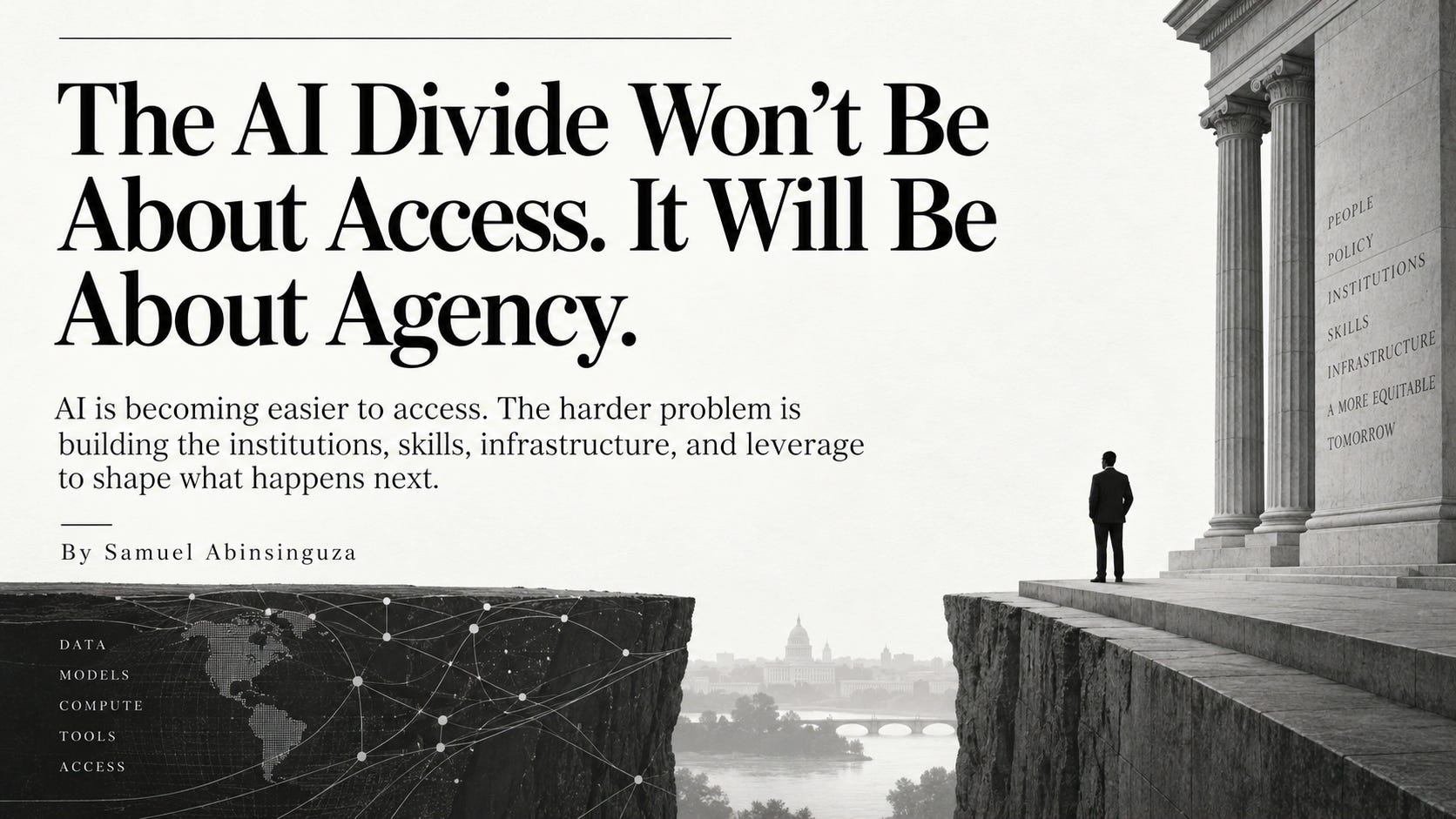
The harder question is whether they will have enough agency to shape what happens after it arrives.
Access is not the same as inclusion
There is a version of AI inclusion that is fundamentally about access.
Can people use the models?
Can developers access compute?
Can a student in Kampala use the same AI assistant as a student in Boston?
Can a small business integrate increasingly capable AI tools?
These things matter enormously.
And access is likely to improve.
Models are getting cheaper. Open models are improving. AI capabilities are being embedded into products people already use. Cloud infrastructure makes sophisticated computing resources available far beyond the countries in which the physical infrastructure sits.
But access alone tells us remarkably little about how the benefits of AI will ultimately be distributed.
A country can have widespread access to AI while capturing very little of the economic value generated by it.
It can consume AI systems while importing the models, cloud infrastructure, standards, evaluation tools, safety mechanisms and, sometimes, the assumptions about what problems are worth solving.
Its businesses can become more productive while becoming more dependent on infrastructure controlled elsewhere.
Its government can deploy AI without developing the capacity to evaluate what it is buying.
Its citizens can become intensive users of AI without gaining much influence over how those systems are designed or governed.
So widespread diffusion does not necessarily mean widespread power.
That distinction matters.
The AI divide is changing
The conventional digital divide was often understood in terms of access.
Who had an internet connection?
Who had a computer?
Who owned a smartphone?
Who could afford data?
Those divides have not disappeared. But AI introduces another layer.
The World Bank now describes four foundations for meaningful AI participation: connectivity, compute, context and competency.
Connectivity means reliable digital infrastructure and electricity.
Compute means access to chips, data centers and cloud infrastructure.
Context means the data, languages, applications and knowledge that make systems useful locally.
Competency means the skills required not simply to use AI, but to adapt and innovate with it.
These foundations are distributed very unevenly.
The World Bank’s Digital Progress and Trends Report 2025 documents substantial disparities in secure internet infrastructure, data-center capacity, high-performance computing, and AI-relevant skills across regions.
That does not mean every African country needs to build frontier-scale computing infrastructure.
It does mean that access to an AI interface should not be mistaken for participation in the deeper AI economy.
There is a difference between being able to use intelligence produced elsewhere and having the capacity to adapt, evaluate, govern and create with it locally.
That is where the next divide may emerge.
I would measure inclusion differently
If we want to know whether AI diffusion is genuinely inclusive, counting users will not be enough.
I would add three questions.
Who has agency?
Can local institutions, businesses, researchers, governments and communities influence how AI is deployed?
Can they decide which problems should receive attention?
Can they adapt systems to local languages, laws, cultures and institutional realities?
Can governments establish meaningful conditions for companies operating in their markets?
Or are countries simply choosing among technologies, standards and business models developed elsewhere?
Who captures the value?
If AI increases productivity across an economy, where does the resulting value accumulate?
Does it create new local companies?
Does it produce skilled employment?
Does it strengthen research institutions?
Does it produce intellectual property and expertise locally?
Does it increase the bargaining power of local firms and governments?
Or does most of the economic value flow through foreign platforms, infrastructure providers and intellectual-property owners?
What remains after deployment?
This may be the most important question.
Suppose an AI system is introduced into a ministry, university, hospital or agricultural programme.
Five years later, what capability remains?
Can the institution evaluate the system?
Can it recognize when performance deteriorates?
Can it procure a replacement intelligently?
Can it negotiate effectively with vendors?
Does it have people capable of adapting the technology?
Has the deployment created better datasets?
Has it strengthened domestic companies or researchers?
In other words:
Did AI merely arrive, or did capability accumulate?
That is a much more demanding measure of inclusion.
The architecture of diffusion is governance
This is also where I think our conception of AI governance needs to become broader.
AI governance is often presented primarily as regulation.
Laws.
Risk classifications.
Technical standards.
Safety requirements.
Restrictions on certain uses.
These are important.
But they are only part of the field.
I think of AI governance more broadly as the field of inquiry and practice concerned with how societies should shape the institutions, incentives, infrastructures, norms and safeguards surrounding AI so that its benefits are broadly shared and harmful patterns are addressed before they become embedded at scale.
Seen this way, governance is not something that happens after AI diffusion.
The architecture of diffusion is governance.
Who receives access to compute is partly a governance question.
What governments procure is a governance question.
What conditions they attach to those contracts is a governance question.
Which languages receive investment is a governance question.
How public data can be used is a governance question.
Which startups receive financing is shaped by institutional choices.
Whether universities develop local AI expertise is shaped by institutional choices.
Whether governments become permanently dependent on a small number of external technology providers is, eventually, a governance outcome.
Governance therefore cannot be reduced to asking:
How should we regulate AI?
It must also ask:
What kinds of AI ecosystems are our institutions creating?
That shift matters particularly for developing economies.
Governance is not simply about constraining technology.
Done well, it can create the conditions under which societies gain greater capacity to use and shape technology.
Human capability is infrastructure
We normally hear the word infrastructure and think about cables, electricity, data centers and GPUs.
Those things are indispensable.
But another form of infrastructure may prove just as important.
People.
The engineer adapting a model for an African language.
The evaluator determining whether a health system actually works in a particular clinical environment.
The civil servant who understands enough about AI to write a competent procurement contract.
The researcher building datasets that otherwise would not exist.
The policy expert translating a principle such as fairness or accountability into something implementable.
The entrepreneur who understands a local problem deeply enough to recognize where AI is useful and where it is not.
The technician responsible for monitoring an AI system after deployment.
These people are not peripheral to AI diffusion.
They are part of the infrastructure through which diffusion happens.
UNDP has begun making a similar argument explicitly.
Its AI Diffusion Workforce and Tools Accelerator argues that deploying AI effectively across different sectors, languages and contexts requires a surrounding workforce capable of adapting, evaluating, monitoring and maintaining AI systems.
That is an important shift.
The challenge is not simply getting AI into more places.
It is building enough surrounding capability for those places to use it well.
Africa should optimize for capability accumulation
This leads to a different development objective.
Instead of asking only how quickly African countries can adopt AI, we should ask how much capability each deployment leaves behind.
Imagine two countries.
Both deploy AI rapidly over the next decade.
In the first, most important systems are imported.
Local organizations use them successfully.
Productivity improves.
But the underlying systems remain poorly understood locally. Procurement depends heavily on vendors. Evaluation capacity remains weak. Domestic firms occupy relatively thin layers of the value chain.
The country has become an intensive AI user.
But its dependence has increased alongside its adoption.
Now consider the second country.
It also imports technologies. There is nothing inherently wrong with that.
But major deployments are deliberately connected to local universities, startups, researchers, workers and public institutions.
Procurement contracts include provisions for knowledge transfer.
Local datasets are developed.
Domestic evaluators emerge.
Researchers study how systems perform under local conditions.
Government agencies develop technical expertise.
Startups build complementary services.
Capital begins to follow that expertise.
Ten years later, both countries may show similar AI adoption statistics.
But their position in the AI economy will be profoundly different.
One has accumulated consumption.
The other has accumulated capability.
That difference is institutional, not merely technological.
There are signs of this approach already
The African Union’s Continental Artificial Intelligence Strategy points toward an Africa-centric and development-focused approach to AI and connects AI to innovation, new industries, economic development and high-value employment.
That matters because it frames AI not simply as technology to be adopted, but as an ecosystem in which African institutions, firms and governments should have meaningful productive capacity.
UNDP’s AI Hub for Sustainable Development similarly focuses on data, compute, talent and enabling environments as foundations for stronger AI ecosystems across Africa.
At the Nairobi AI Forum 2026, partners announced 1.5 million GPU hours for African innovators working in areas including food security, climate resilience and local-language AI.
These initiatives matter because they begin to move the conversation beyond simply providing access to finished AI products.
But the principle needs to go much further.
Every major AI investment, procurement programme, development project and public-private partnership should face a simple test:
What capability will exist here afterward that did not exist before?
Africa is not necessarily late
There is another reason to resist framing this purely as a race to catch up.
AI may be advancing quickly, but its integration into the institutions most important to human development is still remarkably early.
Governments are still figuring out what AI-enabled public administration should look like.
Education systems are still working out what learning means when every student can access sophisticated AI assistance.
Healthcare systems are still developing appropriate roles for AI in diagnosis, administration, research and patient support.
Agriculture, law, financial services and scientific research are undergoing similar transitions.
Many of the institutional choices are still open.
That matters.
Africa has problems, languages, markets, social structures and institutional environments that frontier technology companies will not fully understand and cannot design for from afar.
That creates constraints.
But it also creates entrepreneurial space.
Research space.
Policy space.
Governance space.
The objective should not be to reproduce every layer of the existing AI industry domestically.
Nor should sovereignty become shorthand for technological isolation.
Interdependence is unavoidable.
The more useful question is where strategic capability matters enough that dependence becomes costly.
Countries will answer that question differently.
But they should answer it deliberately.
From readiness to agency
UNDP’s Human Development Report 2025 makes a useful shift in emphasis.
Its central argument is that development in the age of AI will depend not only on what AI itself becomes capable of doing, but on the choices societies make about how those capabilities are integrated into economies, institutions and people’s lives.
That is fundamentally an argument about agency.
And it suggests that we may need to rethink what we mean by AI readiness.
A country should not have to become fully “AI ready” before it is allowed to participate meaningfully in the AI transition.
Some capabilities can be built through participation itself.
The deployment can train the evaluator.
The procurement can strengthen the institution.
The project can generate the dataset.
The startup partnership can transfer knowledge.
The infrastructure investment can create a local ecosystem.
The question is whether we design diffusion to produce those outcomes.
The divide that matters
I would resist a future in which the measure of success is simply that everyone in Africa can access the same AI assistant available everywhere else.
That would be progress.
But it would be incomplete.
A genuinely inclusive AI future would mean Africans are also building companies, producing research, creating datasets, conducting evaluations, writing standards, designing safeguards, developing infrastructure, setting policy and deciding which problems AI should solve.
AI may eventually become ubiquitous.
If that happens, the most consequential divide may no longer be between societies that have AI and those that do not.
It may be between societies that possess enough institutional, economic and technical capacity to shape AI and those that primarily receive it.
Access determines whether you can use the technology.
Agency determines whether you have a meaningful role in deciding what the technology becomes.
We should be building for both.
Further reading
UNDP, Human Development Report 2025: A Matter of Choice: People and Possibilities in the Age of AI
World Bank, Digital Progress and Trends Report 2025: Strengthening AI Foundations
Samuel Abinsinguza works at the intersection of AI governance, emerging technology policy, institutional capacity and Africa’s role in shaping the future of AI.