

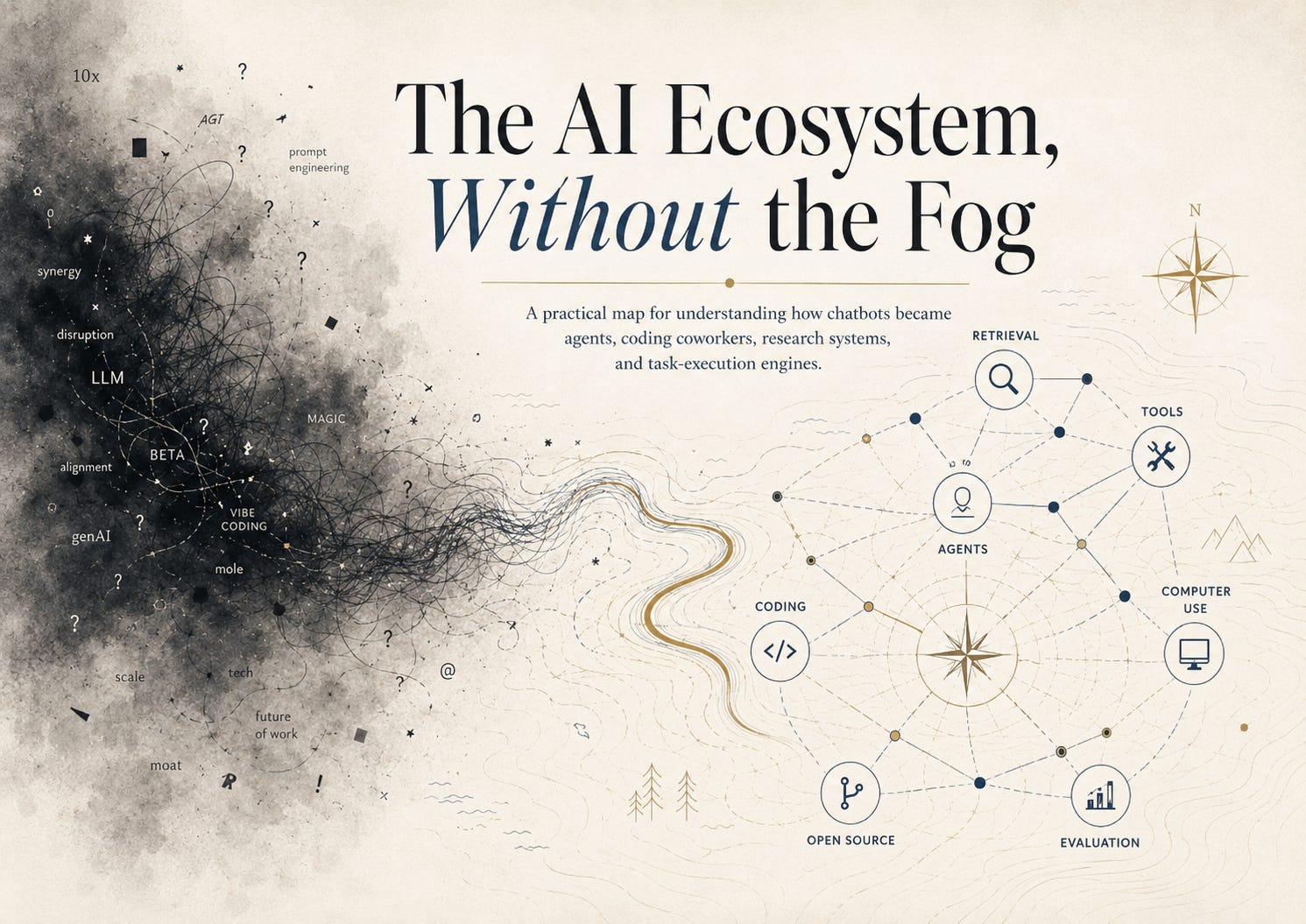
If you feel behind on AI, the most important thing to know is this: you are not behind because you are not that technical.
You feel behind because the field is changing across several layers at once.
One week, everyone is talking about RAG. The next week, it is MCP servers, Claude computer use, Codex, GitHub coding agents, Manus-style workflows, Perplexity-style research agents, open-source models, evals, and another frontier model release.
Every product announcement sounds urgent. Every acronym feels like a new doorway you have not walked through yet. Every demo seems to imply that everyone else already understands what is happening.
But the confusion is not personal. It is structural.
AI is no longer one thing. It is not just a chatbot, a model, a search engine, a coding assistant, or a productivity tool. It is becoming an ecosystem of models, tools, retrieval systems, connectors, software interfaces, agent loops, evaluation methods, and human oversight.
The way out is not to memorize every term. The way out is to see the pattern underneath them.
Here is the pattern:
AI is moving from content generation to task execution.
The first wave of AI was, “Can this model write, summarize, translate, explain, or brainstorm?”
The current wave is, “Can this system gather context, use tools, operate software, check its work, and deliver a useful outcome?”
That one shift explains almost everything: RAG, agents, MCP, computer use, open-source tooling, evals, and the race among frontier labs. They are not separate trends. They are pieces of the same machine taking shape.
The future of AI will is not just being defined by only those who have the smartest chatbot. It will is being defined by who can turn intelligence into reliable work.
From Talking Box to Working System
The public first learned to understand AI through the chatbots.
You typed a prompt. The model replied. Sometimes it wrote beautifully. Sometimes it hallucinated. Sometimes it felt like magic. Sometimes it felt like a confident intern who had not read the file.
That interface was powerful because it made AI approachable. A blank text box meant anyone could try it. You did not need to code. You did not need to understand machine learning. You could simply ask.
But the chatbot interface also created a misleading mental model. It made AI look like a conversation partner when the deeper shift was architectural.
A modern AI system is not just a model replying to text. It may include a language model, a retrieval layer, access to documents, a browser, a code environment, API tools, memory, permissions, logs, human approval steps, and evaluation tests. OpenAI’s agent documentation describes agents as applications that can plan, call tools, coordinate specialist agents, and maintain state across multi-step work. That definition matters because it moves the focus away from “the model” and toward “the system around the model.”
That is the first major realization:
The model is not the product. The workflow is the product.
Here is another way to think about it…
A chatbot can answer. A system can work.
This is why all the new AI terms belong in the same conversation. RAG gives the system better context. Tool use gives it abilities. Agents give it a loop. MCP gives it standardized connections. Computer use gives it a way to operate interfaces. Coding agents give it a testable work environment. Evals ask whether any of it actually works.
The fog begins to clear when you stop asking, “What does this acronym mean?” and start asking, “What missing capability does this add to the system?”
The Short History: How We Got Here
The story begins with chat, but it does not end there.
Early consumer chatbots made AI conversational. GPT-style models made that conversation broadly useful. Suddenly, one interface could draft a memo, explain a legal concept, debug a snippet of code, summarize a paper, outline a business plan, and role-play a customer interview.
That generality was the breakthrough. It was also the weakness.
A general model can sound intelligent while lacking the specific facts needed for real work. It may not know your company documents, your codebase, your current customer data, or the latest version of a law, product, or technical standard.
So RAG emerged.
Retrieval-Augmented Generation gave AI a way to search external information before answering. Instead of relying only on what was baked into the model during training, the system could retrieve relevant passages from documents, databases, or websites and then generate an answer based on that material.
But retrieval still mostly helped AI answer.
Users wanted more. They wanted AI to search the web, run calculations, write files, inspect repositories, execute code, update spreadsheets, and interact with business systems.
So tool use emerged.
Then came the next problem: many useful tasks are not one-step tasks. Research requires searching, reading, comparing, drafting, and revising. Coding requires inspecting files, editing, running tests, reading errors, and trying again. Operations work may involve opening dashboards, gathering numbers, checking anomalies, and producing a report.
So agents emerged.
An agent is a system that can move through a loop: observe, decide, act, check, and continue.
But as soon as agents started using tools, another problem appeared. Every AI application needed custom connections to every data source, file system, repository, database, and business tool.
So MCP emerged.
The Model Context Protocol, introduced by Anthropic, is best understood as a standard connector layer. It gives AI tools a cleaner way to connect to external systems. If RAG gives the model a library card, MCP gives the AI application a standard way to plug into the library, the office, the filing cabinet, and the workshop.
Then came another limitation: not every useful task has a clean API. Much of human work still happens inside websites, dashboards, forms, spreadsheets, internal tools, and apps designed for human eyes and hands.
So computer use emerged.
Computer-use systems allow a model to inspect screenshots and choose interface actions: click here, type there, open this menu, copy that value. The AI is no longer only calling structured tools. It is operating software through the same visual layer humans use.
Finally, coding agents became the proving ground.
Why coding? Because software has unusually good feedback loops. Tests pass or fail. Linters complain. Builds break. Git records changes. Pull requests create review points. Logs explain what happened. The machine can try something, observe the result, and adjust.
That is the timeline:
Chat made AI approachable. Retrieval grounded it. Tools made it useful. Loops made it agentic. Connectors scaled it. Computer use gave it hands. Coding gave it feedback. Evals gave it a reality check.
That sequence is the map.
RAG: Giving the Model a Library Card
RAG stands for Retrieval-Augmented Generation.
The phrase sounds technical, but the idea is simple: before the model answers, the system searches for relevant information.
Imagine a company has 300 internal policy documents. An employee asks, “Can I expense this international trip?” A normal chatbot may answer from general knowledge about business travel. A RAG system searches the company’s actual policy documents, retrieves the relevant passages, and then answers based on those sources.
That is why RAG matters. Real work depends on specific information. Contracts. HR policies. Research papers. Product manuals. Customer histories. Compliance documents. Engineering docs. A model trained months ago cannot reliably know all of that.
RAG solves the isolation problem.
But it does not solve the truth problem.
That is the side insight many people miss. RAG does not make AI automatically factual. It makes the answer more source-aware. If the search retrieves the wrong passage, misses the key document, or feeds the model ambiguous evidence, the final answer can still be wrong.
RAG is not a truth machine. It is a context machine.
Its value is not that it eliminates human judgment. Its value is that it gives the model something better to reason from than memory alone.
Agents: The Loop Is the Breakthrough
An agent is not just a chatbot with a more dramatic name.
An agent is a model inside a loop.
It observes the situation, decides what to do next, uses a tool, reads the result, and continues until it reaches a stopping point.
That loop is the heart of agentic AI.
A research agent might search the web, open sources, compare claims, draft a report, check citations, and summarize what it found. A coding agent might inspect a codebase, edit files, run tests, read the failure, fix the bug, and prepare a pull request. A business operations agent might open a dashboard, export data, compare week-over-week trends, identify anomalies, and draft a morning briefing.
The old chatbot gave you an answer. The agent tries to produce an outcome.
That is a profound shift, but it is also where the hype becomes dangerous.
The misunderstood word is “autonomous.”
People hear “agent” and imagine a fully independent digital worker. In reality, today’s agents are most useful when the task is bounded, the tools are clear, the environment is controlled, and a human reviews important outputs.
A good agent is not magic. It is a disciplined workflow with a model inside it.
Perplexity-style deep research tools show one version of the pattern: search broadly, read sources, reason across them, and produce a report. Manus-style systems show another: give the AI a sandboxed computer, files, browser access, and a broader task objective. These products point toward a future where AI is not just responding to questions but assembling work products.
The overlooked insight is that agents do not remove process. They make process more important.
The more freedom you give an AI system, the more structure you need around it.
Permissions, logs, sandboxes, approval gates, rollback, evaluation, and human review become more important, not less.
MCP: The Boring Layer That Might Matter Most
MCP, the Model Context Protocol, is easy to underestimate because it sounds like plumbing.
But plumbing is what turns isolated tools into infrastructure.
Anthropic introduced MCP as an open standard for connecting AI assistants to the places where data and tools live: repositories, business systems, local files, development environments, databases, and internal services.
The simplest way to understand MCP is this:
MCP is USB-C for AI tools.
That comparison is imperfect, but useful. Before common standards, every device needed a special cable. Before connector standards for AI, every model-powered application needed custom integrations. MCP tries to make tool and data connections more reusable.
This matters because the future of AI is not one chatbot that knows everything. It is many AI systems that need controlled access to many sources of context and action.
A coding agent may need access to GitHub, a local file system, issue trackers, design docs, a terminal, and deployment logs. A research assistant may need access to a citation manager, web search, PDFs, notes, and a writing environment. A business agent may need access to CRM data, analytics dashboards, email, spreadsheets, and internal documents.
Without connectors, every workflow becomes custom glue. With connectors, the ecosystem becomes easier to extend.
The insight here is that MCP is not exciting because it makes models smarter. It is exciting because it makes systems more composable.
The next AI breakthrough may look less like a smarter brain and more like a better nervous system.
Computer Use: Giving AI Hands, Not Judgment
Computer use is one of the most visually striking developments because it makes AI look like it is using a computer the way a person does.
The model sees a screenshot. It decides what action to take. It clicks, types, scrolls, opens menus, fills forms, or navigates a website. OpenAI and Anthropic both describe versions of this pattern: the model interprets the screen and returns interface actions that software can execute.
This is powerful because many valuable workflows still live behind graphical interfaces. Not every system has an API. Not every company has clean internal tooling. Not every task can be reduced to a neat function call.
Sometimes the only interface is the same one humans use.
But computer use is also brittle.
Web pages change. Buttons move. Pop-ups appear. Login screens interrupt the flow. A model may misread an interface. A malicious page may try to manipulate the agent with hidden instructions. A task that looks simple to a human can become fragile when performed through screenshots and simulated clicks.
That is why computer use should not be mistaken for mature autonomy.
It gives AI hands. It does not give AI judgment.
The useful frame is this:
Computer use is a bridge technology. It lets AI operate today’s messy software while we slowly build more AI-native interfaces underneath.
In the short term, agents will need to use the same screens humans use. In the long term, many workflows may be redesigned so AI systems interact through safer, structured, auditable layers.
Coding Agents: The First Serious Arena
Software development became the first serious arena for agents because code gives AI something rare: feedback.
OpenAI’s Codex is described as a cloud-based software engineering agent that can work on multiple tasks in parallel, write features, answer questions about a codebase, fix bugs, and propose pull requests for review. Each task can run in a sandboxed environment preloaded with a repository. GitHub’s Copilot coding agent similarly can research a repository, create an implementation plan, make code changes on a branch, run tests and linters in a GitHub Actions-powered environment, and prepare work for human review.
This is not just autocomplete. It is a shift from code suggestion to code delegation.
A developer no longer only asks, “Can you write this function?” The developer can ask, “Can you investigate this bug, find the relevant files, patch the issue, run the tests, and show me the diff?”
That changes the developer’s job.
It does not eliminate developers. It moves more value toward task design, system architecture, review, testing, security, and taste.
The best developers will not be the ones who simply type fastest. They will be the ones who can define the right work, constrain the agent, inspect its output, and know when not to trust it.
The contrarian point is that AI may make weak engineering practices more painful, not less.
If a codebase has no tests, unclear architecture, poor documentation, and no review culture, agents have less reliable feedback. The AI cannot easily tell whether it improved the system or quietly damaged it.
Agents do not remove the need for good engineering discipline. They reward it.
A clean codebase becomes more agent-ready. A messy one becomes a confusion engine.
Frontier Labs: The Race Is No Longer Just About Chat
The major frontier labs are often discussed as if they are all doing the same thing: building bigger models.
That is too simple.
They are competing to build full AI work platforms.
OpenAI’s direction is increasingly agentic: Codex for software work, tool use, agent SDKs, computer use, and environments where models can perform bounded tasks. Its strategic question is not only “How smart is the model?” but “How much useful work can the model complete inside a controlled environment?”
Anthropic’s direction emphasizes Claude as a tool-using collaborator: Claude Code, computer use, MCP, and safety-conscious agent design. Anthropic’s influence is not only model quality. It is also shaping how developers think about permissions, connectors, tool access, and human approval.
Google DeepMind brings a different advantage: models connected to a vast ecosystem of search, Android, Workspace, cloud infrastructure, and multimodal products. Its Gemini direction points toward AI that can reason across text, images, video, code, and everyday productivity environments.
Meta’s strategy is different again. Through Llama, Meta pushes open-weight models into the developer ecosystem. That matters because open models allow more customization, local deployment, experimentation, and institutional control than fully closed systems. Meta is not just competing through a chatbot; it is competing through distribution and developer adoption.
Perplexity represents another branch: AI as an answer and research interface. Its importance is not that it replaces all research, but that it shows how search, source retrieval, synthesis, and report-writing can merge into one workflow.
Manus-style products represent yet another branch: AI as a task-execution workspace. Instead of asking a chatbot for advice, the user gives the system an objective and watches it plan, browse, compute, create files, and deliver an output.
The ignored insight is this:
The AI race is not one race. It is several races stacked together.
There is a model race, a product race, a workflow race, a connector race, an infrastructure race, a safety race, a distribution race, and a trust race.
The winner in one layer may not automatically win the others.
Open Source and GitHub: Where the Ecosystem Learns in Public
Open source plays a different role from frontier labs.
Frontier labs often push capability at the edge. Open-source communities turn ideas into experiments, forks, tools, wrappers, agents, connectors, and strange prototypes that reveal what people actually want to build.
Meta’s Llama releases are important because open-weight models let developers run, adapt, inspect, and deploy systems in ways that closed products do not always allow. Around those models, GitHub becomes the live laboratory of the AI ecosystem.
This is where you find agent frameworks, MCP servers, local AI assistants, browser controllers, evaluation harnesses, fine-tuning recipes, coding tools, and orchestration layers. Some projects will disappear. Some will be insecure. Some will be demos pretending to be products. But collectively, they show where builders are pushing.
The frontier labs tell you what is becoming possible at the high end. GitHub tells you what developers are trying to make usable.
That distinction matters.
Closed labs reveal capability. Open source reveals direction.
Open source is not only about cheaper alternatives. It is about experimentation, transparency, adaptation, and control. For companies, governments, researchers, and builders outside the largest AI labs, that control matters. It affects cost, sovereignty, privacy, customization, and resilience.
But open source also has its own trap. People sometimes assume that because something is open, it is automatically safer, better, or more democratic. That is not true. Open tools still require evaluation, governance, maintenance, security review, and serious deployment discipline.
Open source gives you access. It does not give you judgment.
Evals: The Reality Check After the Demo
As AI systems move from answers to actions, evaluation becomes the central discipline.
A demo can show one impressive run. Production needs repeated performance under messy conditions.
That is the gap evals are meant to address.
OpenAI describes evals as tests that check whether outputs meet specified criteria and help improve applications. METR studies whether frontier AI systems can autonomously complete real tasks and tracks task-completion time horizons: the length of task, measured by human expert time, at which an AI system succeeds with a given level of reliability.
That framing is useful because it replaces vibes with measurement.
Instead of asking, “Did the demo look impressive?” ask:
What was the task? How long would it take a skilled human? How often did the AI succeed? What tools did it have? Was the environment realistic? Did it receive hints? Could it recover from mistakes? What happened when the task changed slightly?
The insight here is that AI progress may be less smooth than product launches make it appear.
A system can be excellent at 10-minute tasks and unreliable at 2-hour tasks. It can perform well in coding and poorly in messy administrative workflows. It can succeed when the environment is clean and fail when the interface changes. It can look brilliant in a benchmark and fragile in a real organization.
Reliability is the difference between a demo and a delegation.
That is why evals matter. As AI becomes more capable, the question shifts from “Can it do this once?” to “Can we trust it to do this repeatedly, under constraints, with consequences?”
The Deeper Pattern: AI Is Becoming Infrastructure
The biggest mistake is to treat every AI launch as a separate event.
A better approach is to place each launch on the map.
Is this a better model? A better retrieval system? A new connector? A tool-use environment? An agent loop? A computer-use interface? A coding workflow? An eval? A governance layer? A distribution play?
Once you ask those questions, the ecosystem becomes legible.
The deeper pattern is architectural:
AI is moving from answers to actions. From prompts to workflows. From chatbots to agents. From isolated models to connected systems. From static knowledge to retrieved context. From human-only software to AI-operated software. From impressive demos to measured reliability. From individual productivity hacks to institutional redesign.
This does not mean every job disappears or every process becomes autonomous. That is the lazy version of the story.
The sharper version is that AI changes where human judgment sits.
In the chatbot era, humans did the work and used AI for assistance. In the agent era, AI may do more of the first draft, first search, first pass, first implementation, or first analysis. Humans move toward framing, review, exception handling, accountability, and taste.
That can be empowering. It can also be destabilizing.
People who understand the system will use AI as leverage. People who only chase tools will feel permanently behind.
The durable skill is not knowing every app. The durable skill is knowing where each app fits in the system.
What This Means for Different People
For software developers, the opportunity is no longer only learning how to call an API. It is learning how to design agent-ready systems: clear tasks, strong tests, structured logs, permission boundaries, readable codebases, review workflows, and safe deployment paths.
The developer of the future is part architect, part reviewer, part toolsmith, and part systems designer.
For researchers, AI becomes both an assistant and a methodological risk. It can accelerate literature review, source discovery, summarization, coding, and synthesis. But it can also launder weak sources into confident prose. The researcher’s edge will come from better questions, better verification, and better judgment about evidence.
For entrepreneurs, the question is not “Where can I add a chatbot?” That is usually the shallow move. The better question is, “Which painful workflow can be delegated, checked, and improved?” The opportunity is not chat as decoration. It is workflow redesign.
For policy thinkers, the issue is no longer only bias or misinformation. Those still matter, but agentic systems introduce deeper questions: delegation, liability, auditability, labor displacement, cyber risk, procurement standards, evaluation thresholds, concentration of power, and human control over systems that can act.
For students, the durable skill is not memorizing AI terminology. It is learning how to learn with AI: ask precise questions, test answers, compare sources, build small projects, and understand where the tool fails. The student who uses AI only to avoid thinking will become weaker.
The student who uses AI to increase the number and quality of thinking loops will become stronger.
For writers, AI is less interesting as a sentence generator than as a research partner, editor, argument tester, structure coach, and pattern detector. The danger is generic fluency. The opportunity is sharper thinking.
For business operators, the practical move is to map repetitive knowledge work. Where do people gather information, compare options, update records, produce reports, check compliance, or triage requests? Those are the places AI can assist under human review.
The common thread is this:
AI literacy is becoming systems literacy.
The important question is not merely “Can I prompt well?” It is “Can I understand the workflow, the context, the tools, the risks, and the feedback loop?”
Where to Start
Do not try to learn everything.
Learn the map in sequence.
In week one, use chat models deeply. Do not just ask random questions. Use them for writing, summarizing, planning, explaining, comparing, and critiquing. Learn the baseline: what a model can do with only a prompt.
In week two, learn RAG. Use a tool that answers from uploaded documents. Ask questions where the answer depends on the source. Notice when retrieval helps. Notice when it misses. Learn the difference between a fluent answer and a grounded answer.
In week three, try a research or coding agent on a bounded task. Give it something small enough to verify: summarize five sources, compare two tools, fix a minor bug, draft a project plan, or inspect a repository. Watch the loop. Where does it search? Where does it guess? Where does it get stuck?
In week four, learn MCP and connectors. Do not worry about every technical detail at first. Understand the principle: AI systems need controlled ways to access tools and data. Ask what is connected, what permissions exist, and what the model is allowed to do.
In week five, study computer use. Watch how an AI system operates a browser or desktop. Notice both the power and the brittleness. This will cure both naive hype and naive dismissal.
In week six, follow frontier labs with a map. When OpenAI, Anthropic, Google DeepMind, Meta, Perplexity, or another player releases something, classify it. Is it model capability, tool use, workflow, distribution, safety, or evaluation?
In week seven, explore GitHub and open-source AI. Look at agent frameworks, MCP servers, local AI tools, browser agents, coding assistants, and harnesses like openclaw or hermes agent. Do not try to use everything at a go. Learn what builders are experimenting with.
In week eight, learn evals. For every impressive claim, ask what was measured, under what conditions, at what reliability, and against what baseline.
That is how you catch up without drowning.
The goal is not to know every tool. The goal is to stop being surprised by every new name.
The next AI launch should not feel like a random object dropped into the room. You should know where to place it. Is it a better model? A retrieval layer? A connector? An agent loop? A computer-use interface? A coding workflow? An evaluation claim?
That is the value of understanding the concepts map.
Action for you: Share this article with a caption of an insight, an idea, a realization or question you got from reading it.
Or leave a comment below. Thank you.
Love what you've done here, but listen. This is still way too technical for the average person. Too many terms are thrown in that people don't know. I'm only halfway through it, and already I could spend a lot of time looking up terms I've never heard before ... and my career was in IT (1978-2006). I can imagine people I know throwing up their hands only a quarter of the way through, and then calling me to ask a million questions. Next time, break it up into smaller articles, and don't introduce so many terms that developers use (or people familiar with IT).
This is why people prefer the use of their phones instead of computers. Nobody has to explain a gazillion in-house terms & acronyms in order for them to use those devices. I'm not one of them. I use my computers 99% of the time. Nobody has to explain anything to them in order to use AI without even knowing it. They're shoving that crap on folks with a force I've never seen before.
People don't even know search engines are using AI now, and it spits out inaccuracies that are difficult to explain. Happened to me yesterday with a friend who is not technical in the least. I ended up arguing with her to explain why what ChatGPT returned was inaccurate. My real-life experience was far more accurate than what Google told her. She would claim this article was too difficult to read after a few paragraphs.
Quite frankly, I'm horrified by the future of AI because it has fallen into the wrong hands and those people have little-to-no integrity. They don't care if AI is inaccurate as hell, as long as they can write their own bias into all those pieces. Of course AI doesn't care if it's inaccurate or has no integrity, either. Who is seeing to it that it does? It's a shiny new toy, and lots of people are having fun with it without realizing it's a whole system of systems with multiple entry points.
I know you spent a good amount of time putting this together and it's excellent for non-developer IT personnel. Good job.