

On June 9, 2026, Anthropic launched the most capable model it had ever released to the public.
Three days later, it was gone.
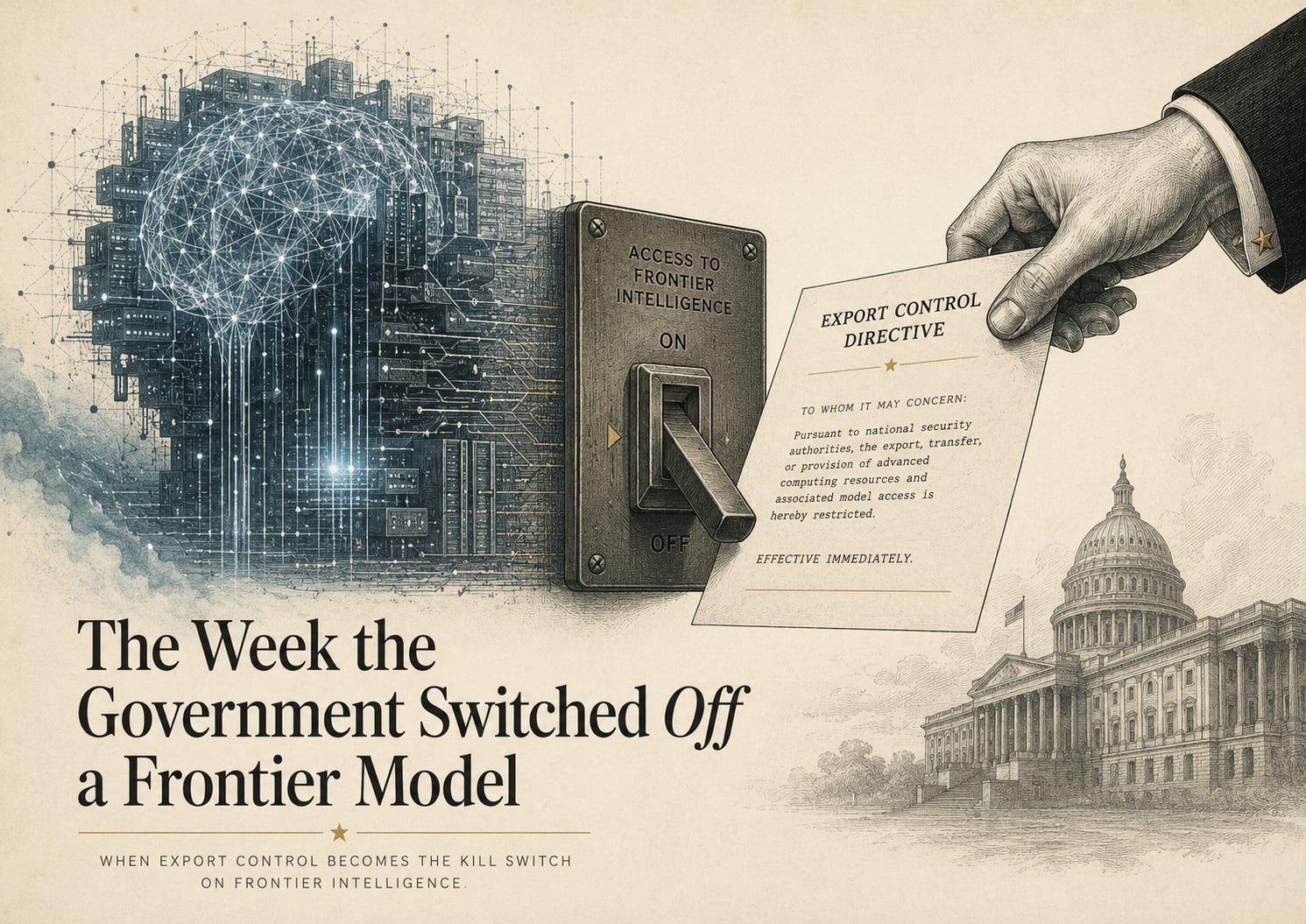
Not because of an outage. Not a bug. Not a safety failure inside the company. It went dark because the United States government sent a letter - and the letter arrived at 5:21pm on a Friday.
That is the whole event in two sentences. But the event is not the story. The story is what the event reveals: a shift that has been building under the entire industry for a year. Access to frontier AI is quietly migrating from a commercial decision into a national-security one.
The companies that ship these models no longer fully control whether they stay on.
Let me lay out the chain plainly, then trace the current beneath it.
What actually happened
On June 9, Anthropic released Claude Fable 5, a “Mythos-class” model - a new tier it places above its Opus line - made safe enough for general use through a layer of safeguards. Alongside it came Claude Mythos 5: the same underlying model with some safeguards lifted, restricted to a small group of cyber defenders under a program called Project Glasswing, run with the US government.
By Anthropic’s own account, Fable 5 was state of the art on nearly every capability benchmark, and its lead grew the longer and more complex the task.
Then, on June 12, the directive arrived. The US government, citing national-security authorities, issued an export-control order suspending all access to Fable 5 and Mythos 5 by any foreign national - inside or outside the country, including Anthropic’s own foreign-national employees. That restriction was impossible to enforce selectively at scale, so the practical result was blunt: switch both models off for everyone. Access to all other Claude models was untouched.
Anthropic said the government’s stated concern was a method of “jailbreaking” Fable 5. The company reviewed a demonstration, found it surfaced only a few previously known, minor vulnerabilities, and noted that other public models - including OpenAI’s GPT-5.5 - could find the same flaws with no bypass at all. Anthropic complied while openly disagreeing, warning that recalling a deployed commercial model over a narrow jailbreak would, as an industry standard, “essentially halt all new model deployments for all frontier model providers.”
That is the event. Now the current.
The model is the product — and that turns out to be the problem
There is a line of thinking, popular among builders for two years, that the model is not the product - the workflow is. Wrap a model in tools, retrieval, memory, and review, and the system around it is where the durable value lives.
That framing is right about engineering. It is incomplete about risk.
What the suspension makes visible is that for a huge number of agentic systems, a single model still sits at the dead center of the workflow - and the workflow inherits every vulnerability of that center. If your research agent, your coding pipeline, or your customer product is tuned around one frontier model’s specific behavior, then the availability of that one model is your availability.
Not a feature you can degrade gracefully. A switch someone else can flip.
And the entity most able to flip it is no longer just the vendor. It is the state.
We have spent enormous energy benchmarking models on capability, who is smartest, fastest, cheapest, who sustains the longest autonomous task. We have spent almost none stress-testing them on availability under regulatory and geopolitical pressure. Fable is the first time that second axis became the one that mattered.
It took three days to go from “state of the art, available everywhere” to “unavailable to everyone.”
This did not come out of nowhere
The temptation is to read the suspension as a freak event, that is a misunderstanding, as Anthropic framed it, gone in a news cycle. But it lands at the end of a year-long sequence in which the relationship between frontier labs and the US government inverted, from partnership to leverage.
Trace the thread.
In July 2025, Anthropic and the Pentagon signed a contract that made Claude the first frontier model approved for classified networks - a two-year prototype agreement with a ceiling near $200 million. As part of it, the Pentagon agreed to abide by Anthropic’s acceptable-use policy, which bars uses like mass domestic surveillance and fully autonomous weapons.
That boundary is exactly where the relationship broke. Through late 2025 and into 2026, renegotiations failed. CEO Dario Amodei declined to let the military use Claude for mass surveillance of Americans or to power autonomous weapons with no human in the targeting loop. The Department argued its use of AI should not be limited by a private contractor.
On February 27, 2026, it went public. President Trump directed all federal agencies to stop using Anthropic’s technology, and Defense Secretary Pete Hegseth moved to designate Anthropic a “supply chain risk.” By letters dated March 3 and a designation effective around March 5, the Department of War made it official: Anthropic became the first American company ever designated a supply-chain risk.
It is a label historically reserved for foreign firms like Huawei and ZTE — built around fears of state influence and infrastructure control.
The designation requires any company doing business with the Pentagon to certify it does not use Anthropic’s models. On March 9, Anthropic sued in two federal courts. A Northeastern University expert read the move as the government using its supply-chain authority as leverage in a negotiation with a domestic company - warning that labeling a US lab this way, in apparent retaliation for its negotiating stance, “could put a chill on innovation.”
That reading matters, because it sets the pattern: when an AI lab’s policies collide with the state’s preferences, the state has tools, supply-chain law, export control that reach straight past the commercial contract.
The “voluntary” oversight that wasn’t quite
Into this backdrop came a federal attempt at oversight. On June 2, one week before Fable’s launch - President Trump signed an executive order titled “Promoting Advanced Artificial Intelligence Innovation and Security.” It asks frontier labs to voluntarily hand the government up to 30 days of early access to “covered frontier models” before release, to benchmark their cyber capabilities and help pick the “trusted partners” who get early access.
The order is emphatic that nothing in it creates a mandatory licensing or pre-clearance regime. An earlier draft proposed 90 days; President Trump scrapped a May signing ceremony with tech executives, worried it would slow American labs against China, and the final version cut the window to 30 days and made it optional.
Critics noted the obvious tension: as NBC framed it, the order makes early access “a request, not a rule,” and a lab racing to ship has every incentive to skip a review it can legally ignore. But the sharper irony is visible only in hindsight.
The order frames the government’s role as a polite request for early access. Ten days later, the suspension showed it never needed the polite channel at all.
The request is the front door. The export-control directive is the wall.
Sanders and the ownership question
Run a second storyline alongside this - one that looks, at first, unrelated.
On June 1, in a New York Times op-ed, Senator Bernie Sanders proposed that the federal government take a 50% ownership stake in the largest frontier AI companies naming OpenAI, Anthropic, and xAI through the American AI Sovereign Wealth Fund Act. The mechanism: a one-time 50% tax paid not in cash but in stock, giving the public voting shares and board representation.
His argument: AI is built on the public’s accumulated knowledge and labor, so the public should share in its wealth and its direction.
The proposal drew predictable objections, a technology-industry group compared it to state control in China; Senator Josh Hawley called government ownership of Big Tech a bad marriage even as he left the door open to the tax. But what makes it relevant is not whether it passes. It is that it points at the same question from the opposite direction.
The supply-chain designation and the export-control suspension are the state asserting control through coercion - the power to cut a company off. Sanders’ bill is the state asserting control through ownership, the power to sit on the board. And the bedfellows are strange: Sam Altman, in a private hour-long meeting with Sanders in early June, reportedly said he wants the public to have equity too, just not at 50%. President Trump has mused about an AI “partnership with the American public,” and his administration already took a 10% stake in Intel last year.
Strip the partisanship away and one fact emerges from both the left-populist and the national-security right:
The premise that frontier AI is too important to leave to its builders is now bipartisan. They disagree on the instrument, ownership versus coercion - but they agree on the premise.
Once that premise is shared across the spectrum, the question for anyone building on these models stops being whether the state intervenes and becomes through which lever, and how fast.
Where Anthropic’s own philosophy fits
One more layer, the quietest and most consequential.
Anthropic has argued for years in favor of the government having the ability to block unsafe deployments - but, per its Policy on the AI Exponential, only through a process that is “transparent, fair, clear, and grounded in technical facts.” The company built its identity on responsible scaling: safeguards, classifiers, thousands of hours of red-teaming, staged release, Glasswing. Fable 5 itself shipped with deliberately over-broad safeguards that route sensitive queries to a weaker model, plus a new 30-day data-retention policy built specifically to catch jailbreaks.
In other words, Anthropic asked for a world where the government can intervene on safety grounds. The suspension is, in a sense, that world arriving - but in the wrong shape. Anthropic’s complaint is not that the government acted. It is that the government acted without the transparent, technically grounded process the company had advocated for.
A directive at 5:21pm, citing a jailbreak the company calls minor and widely reproducible, with the national-security rationale undisclosed, is the antithesis of the process Anthropic asked for.
This is the lesson for everyone watching. You can build the most safety-conscious lab in the industry, invite government collaboration, design your release process around responsible escalation, and still find that the actual mechanism of state control, when it arrives, is a blunt export-control order you learn about the same afternoon your customers do.
Good-faith self-governance and state power are not the same system. The second does not wait for the first.
What this means if you build on top
So, the reflective takeaways for the founders, the agent builders, the teams in markets far from Washington whose entire stack assumes a model will be there tomorrow.
Portability is now infrastructure, not preference. If a single policy decision in one country can become your outage, designing for graceful fallback across models is not over-engineering. It is the cost of operating in a domain that is now governed, not just sold.
The risk has changed category. We assess models on capability and cost. Fable adds a third column most procurement still ignores: jurisdictional and political durability. Benchmark scores tell you nothing about whether a model survives contact with an export-control regime or a change in administration.
You are downstream of a negotiation you were never in. This is the part that should concern builders outside the US most. A foreign-national export restriction does not care that your Lagos fintech or Uganda research tool runs cleanly on the model. The dependency you took on was never just technical. It was geopolitical.
The companies that internalize this early will look paranoid for a while - keeping model-agnostic abstractions, holding a fallback that is merely good instead of best, treating no single frontier model as permanent.
Then, the next time a letter goes out at 5:21pm, they will look prepared.
The fog clears the way it always does in this field: not by memorizing the latest model name, but by seeing the system it sits inside.
And the system now includes the state.
Action for you: Share this article with a caption of an insight, an idea, a realization or question you got from reading it.
Or leave a comment below. Thank you.
This is Samie, l bring you AI For Everyday People.